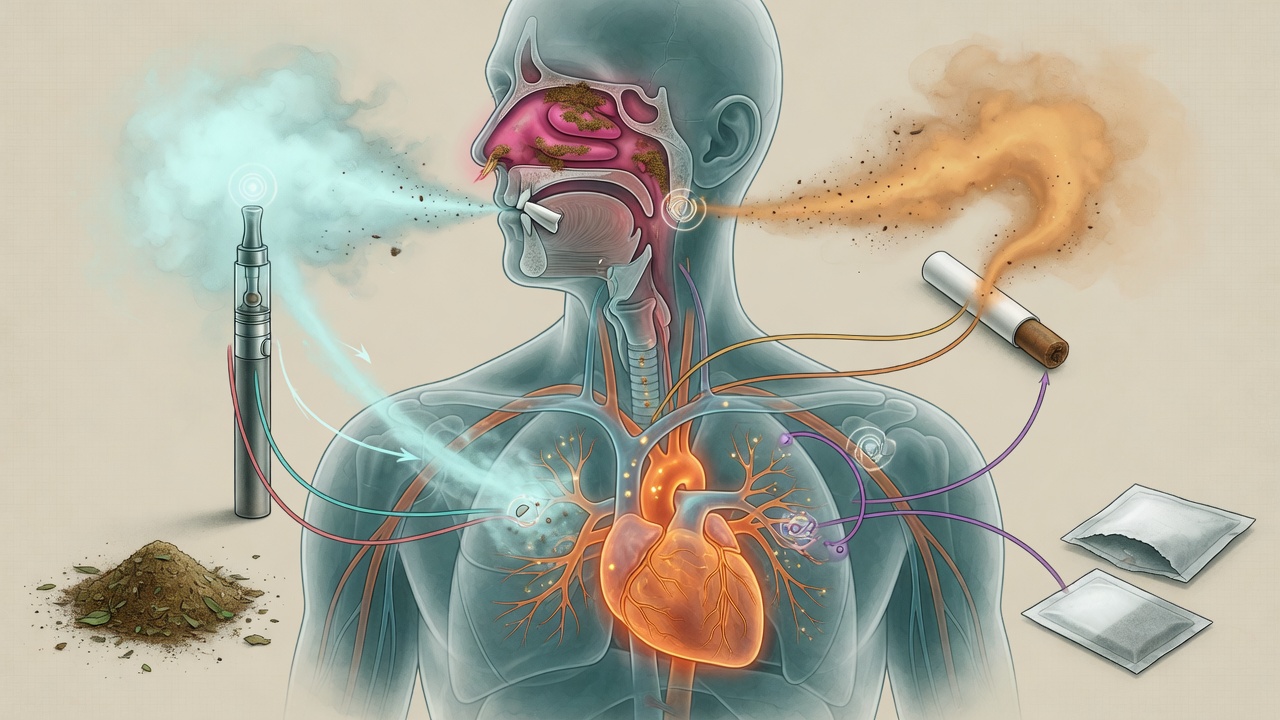
Are "Harm Reduction" Products Really Safer? Evidence from the Nasal, Oral, and Systemic Routes
Claims such as "harm reduction," "lower harm," "heat-not-burn is cleaner," "e-cigarettes are just water vapor," and "snuff doesn't enter the lungs, so it's safer" are widely circulated in the market. Some of these statements originate from relative risk comparisons within public health discourse, some from marketing simplification, and others conflate reduced chemical exposure with eliminated disease risk.
This article systematically reviews existing evidence on so-called "harm reduction" products—e-cigarettes, heated tobacco products, snuff/snus, and oral smokeless tobacco—in a neutral and verifiable manner, addressing three exposure routes—nasal, oral, and systemic—to clarify which conclusions are relatively robust, which remain gaps, and what risks users still face.
Core Pre-Statement (Position of the Full Article):
- Relative to cigarettes, many non-combustible nicotine/tobacco products are often lower in certain harmful and potentially harmful constituents (HPHCs) and exposure biomarkers;
- Relative to complete non-use, they can still cause nicotine addiction, local mucosal damage, and systemic biological effects;
- Reduced exposure ≠ assured health; individual relative harm does not automatically equal net population benefit (dual use, youth initiation, delayed cessation, etc., alter the net effect).
I. Clarifying the Concept: What Does "Harm Reduction" Mean
1. Harm Reduction in Public Health
"Harm reduction" originally means: when a high-risk behavior cannot be immediately eliminated, using strategies proven to significantly reduce harm to decrease mortality, disability, and disease burden. Classic examples include needle exchange programs and opioid maintenance therapy. Its effectiveness depends on:
- Harm is indeed substantially reduced;
- The alternative pathway is accessible, acceptable, and sustainable;
- It does not broadly recruit never-users into addiction;
- It does not significantly impede eventual cessation (if cessation remains the superior endpoint).
2. Points of Controversy in the Tobacco Context
When "harm reduction" is applied to e-cigarettes, heated tobacco, and snuff, the debate is typically not about "whether combustion produces more toxins" (chemically, this is often true), but rather:
| Point of Debate | Meaning |
|---|---|
| What is the endpoint | Is it "better than continuing to smoke" or "approaching non-smoking"? |
| Comparison group | Complete switching in current smokers, or never-smoking adolescents? |
| Use pattern | Complete substitution, or dual use (cigarettes + novel products)? |
| Evidence type | Smoke constituents and biomarkers, or hard endpoints such as myocardial infarction, COPD, cancer? |
| Product homogeneity | Device power, e-liquid formulation, tobacco matrix, and regulatory standards vary enormously—can findings be extrapolated? |
Therefore, scientific statements should preferably be framed as:
"In a certain population, under a certain use pattern, certain exposure indicators are reduced relative to cigarettes; evidence on long-term disease outcomes remains limited; for non-smokers and adolescents, the net risk direction is typically unfavorable."
Rather than a simple assertion: "Harm reduction product = safe product."
II. Product Map: Which Type of Exposure Are You Comparing
| Type | Brief Description | Primary Entry Route | Does "Non-Combustion" Apply? |
|---|---|---|---|
| Conventional cigarettes | High-temperature combustion of tobacco | Mouth → entire respiratory tract → lungs; sidestream smoke via nose | No |
| E-cigarettes (ENDS) | Heating e-liquid to produce aerosol | Mouth → respiratory tract → lungs | Typically yes (no tobacco combustion) |
| Heated tobacco (HTP/HNB) | Heating tobacco substrate (approx. 250–350°C range) | Mouth → respiratory tract → lungs | "Heating without full combustion," but the material is still tobacco |
| Dry snuff | Tobacco powder inhaled through the nose | Primarily nasal mucosa | Yes |
| Moist snuff / snus / some oral tobacco | Placed in the labial-gingival sulcus | Oral mucosa | Yes |
| Nicotine pouches | Tobacco-free nicotine pouches for oral use | Oral mucosa | Yes (no tobacco combustion, and often no tobacco leaf) |
| NRT (patches, gum, etc.) | Pharmaceutical nicotine delivery | Skin / oral cavity, etc. | Pharmaceutical pathway, different evidence base |
Common Point of Confusion: Colloquial "snuff" often conflates nasal dry powder with oral moist snuff. Their local injury pathways differ between the nasal cavity and oral cavity and cannot be generalized.
III. How to Read the Evidence: From Chemistry to Disease
Assessing whether something is "safer" requires at least four tiers. The lower the tier, the closer it is to genuine "health outcomes," and the harder and slower it is to reach conclusions.
Tier 1 Emission/constituent analysis (HPHCs in smoke, aerosol, leachates)
        ↓
Tier 2 Human exposure biomarkers (NNAL, COHb, volatile organic compound metabolites, etc.)
        ↓
Tier 3 Short-term clinical and functional indicators (blood pressure, heart rate, endothelial function, airway inflammation, mucosal pathology)
        ↓
Tier 4 Long-term disease and mortality (coronary heart disease, stroke, COPD, cancer incidence/mortality)
Current Landscape (Overview):
- Tiers 1–2: There is considerable evidence that e-cigarettes and heated tobacco are "lower in some toxins" relative to cigarettes, but this is highly dependent on product and use conditions;
- Tier 3: Signals exist (irritation, inflammation, hemodynamic changes, etc.), but heterogeneity is large;
- Tier 4: Evidence is generally insufficient for novel products; Tier 4 evidence for cigarettes is very extensive.
Therefore, any slogan claiming to have "proven X% safer than cigarettes" without specifying the evidence tier and population should be treated with caution.
IV. Evidence for the Nasal Route: What Truly "Hits the Nose"
1. Dry Nasal Snuff: High Local Concentration, Chronic Irritation
Dry snuff brings tobacco microparticles and soluble chemicals (including nicotine, tobacco-specific nitrosamines TSNAs, etc.) into direct contact with the nasal mucosa. Compared to oral smoking:
- Advantage pathway (relative to pulmonary exposure from cigarettes): It typically does not produce combustion smoke or large amounts of tar-like particles entering the alveoli, thus differing from the smoking-related lung cancer pathway; historically often described as "lower combustion-related exposure to the lungs."
- Specific cost: The nasal cavity becomes the primary and high-dose target organ—mechanical friction plus chemical stimulation combined.
Relatively consistent directional descriptions include:
- Abnormal mucus secretion, chronic rhinitis-like manifestations, recurrent irritating discomfort;
- High mechanistic plausibility of impaired mucociliary clearance (inflammation, epithelial damage);
- Possible involvement of olfactory epithelium and olfactory function (case reports and clinical observations of hyposmia exist; large-scale dose-response epidemiology remains limited);
- Long-term local exposure and nasal/sinus mucosal lesions, as well as historically discussed nasal tumor risk, must be understood by product type and regional exposure patterns, and cannot be directly extrapolated from data on modern low-nitrosamine oral products.
Conclusion: If the "harm reduction narrative" for dry snuff only emphasizes "does not enter the lungs," it systematically underestimates local nasal and systemic nicotine risks.
2. E-cigarettes and Heated Tobacco: The Nasal Route Is Mostly Secondary
During active use, the main pathway is the oral cavity to lower respiratory tract. Nasal involvement arises more from:
- Exhaled aerosol / environmental aerosol;
- Irritation during alternating mouth and nose breathing;
- Consequential effects of overall upper airway inflammatory status.
Existing evidence focuses more on throat irritation, cough, and airway symptoms, rather than the "direct nasal powder impact" seen with dry snuff. They cannot be equated with the local pathology of snuff simply because they "also irritate the nose."
3. Cigarette Sidestream Smoke and Environmental Tobacco Smoke
Secondhand smoke inhaled through the nose is a well-established upper respiratory tract irritant. Regarding whether "secondhand exposure from harm reduction products is significantly lower than from cigarettes," aerosol emission studies suggest it is often lower, but "lower" may still exceed clean air levels, and indoor congregate use may still cause discomfort in sensitive populations (children, asthmatics).
V. Evidence for the Oral Route: Mucosa, Periodontium, and Precancerous Lesion Signals
1. Smokeless Tobacco (Moist Snuff, Some Snus, Chewing Tobacco, etc.)
The oral cavity is the main battlefield. Issues commonly discussed in the literature include:
- Local mucosal changes: Leukoplakia-like lesions / oral leukoplakia, keratosis, ulceration, or chronic irritative damage at the placement site (presentation varies by product, pH, and additives);
- Periodontal and gingival effects: Gingival recession, attachment loss have been repeatedly reported in some smokeless tobacco users;
- Caries and salivary environment: Sugar-containing formulations, salivary buffering, and microbiota alterations may affect caries risk (product-dependent);
- Oral and pharyngeal cancer: Risk is strongly correlated with product nitrosamine levels, use intensity, and regional product type. Low-nitrosamine snus and certain high-TSNA chewing tobacco / moist snuff cannot share the same risk figure.
2. E-cigarettes
No combustion-related tar staining, but they are not "neutral" for the oral cavity:
- Propylene glycol/glycerol, nicotine, and flavoring constituents in the aerosol can cause dry mouth and irritation;
- Research on periodontal inflammatory mediators, subgingival microecology, and wound healing is increasing, with inconsistent directions, but "lighter oral staining than cigarettes" ≠ "periodontal safety";
- At high temperature and power, carbonyl compounds and other substances increase, theoretically raising chemical irritation to the oral mucosa.
3. Heated Tobacco
Still contains tobacco-derived constituents and nicotine. With the oral cavity serving as the aerosol entry point, subjective symptoms such as dryness and irritation may occur; long-term oral cancer hard endpoint data are insufficient. Relative to cigarettes, oral tar-related staining is typically lighter, but oral-pharyngeal exposure to tobacco-derived carcinogens is not zeroed out.
4. Comparative Summary (Oral)
| Product | Oral Characteristics (Overview) | Relative to Cigarettes | Relative to Non-Use |
|---|---|---|---|
| Cigarettes | Tar staining, periodontal disease, mucosal cancer risk—evidence well-established | Baseline, high harm | Significantly harmful |
| E-cigarettes | Irritation, dry mouth, periodontal indicators under study | Staining / some combustion-related damage often lower | Still potentially harmful |
| Heated tobacco | Tobacco aerosol entry irritation | Multiple exposures often lower than cigarettes | Higher than non-use |
| Moist snuff / some smokeless tobacco | Prominent mucosal and gingival damage at placement site | Low pulmonary combustion exposure; oral local can be high | Oral risk not negligible |
| Dry snuff | Oral cavity secondary (may swallow secretions), nasal cavity primary | Different pathway | Nasal + systemic risk |
VI. Evidence for the Systemic Route: Nicotine, Cardiopulmonary, and Cancer-Related Signals
1. Nicotine: Addiction and Cardiovascular Pharmacology
Regardless of whether it comes from cigarettes, e-cigarettes, heated tobacco, or snuff, nicotine can:
- Activate the sympathetic nervous system, elevating heart rate and blood pressure (acute);
- Maintain strong addiction, making cessation difficult;
- Pose particular concern for the developing brain (adolescents through early twenties) regarding attention, emotional regulation, and addiction susceptibility;
- Evidence linking pregnancy exposure to adverse pregnancy outcomes is well-established in tobacco use; high-quality pregnancy cohorts for novel products remain relatively limited, but safety cannot be assumed.
Important distinction:
- NRT used under medical supervision for smoking cessation has a risk-benefit framework different from "long-term recreational nicotine products";
- "Only nicotine, no tar" does not equal the elimination of cardiovascular and developmental risks.
2. E-cigarettes: Reduced Exposure and Residual Harm Relative to Cigarettes
Evidence types relatively supportive of "reduced exposure after switching":
- Concentrations of many harmful constituents in aerosol are often lower than in cigarette smoke;
- Smokers who completely switch to e-cigarettes may show significant reductions in certain tobacco-specific carcinogen exposure biomarkers (e.g., NNAL, etc.) (study design and compliance are critical);
- Public health systems in the UK and elsewhere have long regarded regulated e-cigarettes as one of the tool options for smoking cessation in adult smokers (while emphasizing prevention of youth use).
Remaining risks and uncertainties:
- Aerosol contains ultrafine particles, volatile organic compounds, carbonyl compounds, trace metals, and flavoring-related chemicals;
- Studies on short-term lung function, airway inflammation, and vascular endothelial function show both negative signals and neutral results, with extremely high product and use-pattern heterogeneity;
- EVALI (e-cigarette or vaping product use-associated lung injury) is strongly linked to illicit/specific additives (e.g., vitamin E acetate in some THC products), demonstrating that "inhaling unknown oil-soluble substances" can be fatal, but EVALI cannot simply be attributed as a typical outcome of all nicotine e-cigarettes;
- Evidence on long-term COPD, lung cancer, and cardiovascular disease incidence remains far less than that for cigarettes;
- Dual users (those who both smoke cigarettes and use e-cigarettes) often do not achieve the exposure reduction assumed under "complete switching";
- Increased adolescent use brings addiction and possible gateway effects as points of contention (causal strength varies by study, but preventing non-smoking minors from initiating use is a broad consensus).
Regarding the widely circulated claim of "approximately 95% less harmful than cigarettes": This figure came from early expert assessment work and is not based on decades of precise hard-endpoint measurement; *The Lancet* and others have criticized its methodology. A more cautious formulation is: When completely replacing cigarettes, exposure to many toxins is significantly reduced, but the degree varies by product, and the long-term risk profile cannot be summarized by a single percentage.
3. Heated Tobacco Products (HTP)
Cochrane and other systematic review findings (overview):
- Certain toxicant/carcinogen exposure biomarkers in heated tobacco users are likely lower than in continuing cigarette smokers;
- Compared with those attempting complete tobacco cessation, exposure is often higher;
- High-quality evidence on effectiveness for smoking cessation is insufficient or uncertain;
- Evidence on differences in short-term adverse events is limited; more independently funded long-term research is needed.
WHO and other bodies emphasize: Reduced harmful constituents ≠ proven proportional reduction in health risk, opposing the direct promotion of "exposure reduction" as "harm reduction confirmed" without qualification.
4. Systemic Aspects of Snuff / Oral Products
- Nicotine absorption into the bloodstream can be rapid, effectively maintaining addiction;
- Regarding cardiovascular risk, different reviews on the association of snus and similar products with myocardial infarction/stroke are not entirely consistent, but "smokeless = no cardiovascular risk" does not hold;
- Cancer risk is highly dependent on TSNA and other levels: Scandinavian-type low-nitrosamine snus and high-contamination smokeless tobacco from certain regions are not interchangeable;
- Dry nasal snuff additionally compounds the risk of upper respiratory tract local lesions (see Section IV).
5. Systemic Comparison Table (Simplified)
| Dimension | Relative to Continuing Cigarette Smoking (Complete Switching) | Relative to Never Use | Evidence Notes |
|---|---|---|---|
| CO / partial combustion products | E-cigarettes, HTP, snuff typically substantially reduced | May still be above background | Tiers 1–2 relatively clear |
| Some TSNAs, etc. | Often reduced (product-dependent) | Often still detectable | Dual use attenuates benefit |
| Nicotine addiction | Often maintained | Clear risk | Nicotine salts, etc., may increase dependence |
| Lung parenchyma combustion-related injury pathway | Non-combustible products alter pathway | E-cigarettes/HTP still have aerosol lung exposure | Long-term hard endpoints insufficient |
| Oral/nasal local effects | Pathway redistribution, not necessarily "lighter" | Smokeless tobacco can be locally severe | Depends on product |
| Cardiovascular disease hard endpoints | Tendency toward "possibly lower than cigarettes" but not conclusive | Risk of being higher than non-use warrants vigilance | Tier 4 insufficient |
| Cancer mortality | Cigarette evidence extremely strong; extrapolation for novel products requires caution | Oral risk from high-TSNA smokeless products well-established | Discuss by category |
VII. Product-Specific Evidence Cards (For Easy Reference)
E-cigarettes
- Relatively robust: No tobacco combustion; when completely substituting for cigarettes, many harmful exposure biomarkers are often lower; can serve as a tool option within smoking cessation strategies in some jurisdictions (requires regulation and youth prevention).
- Not robust / gaps: Cancer and mortality data beyond ten years; long-term toxicity of flavor-device combinations; long-term effects on periodontal and metabolic health.
- Clear risks: Nicotine addiction; no health benefit for non-smokers; poor-quality/illicit additives can cause severe lung injury; dual use yields limited benefit.
Heated Tobacco
- Relatively robust: Many HPHCs and some biomarkers are lower than cigarettes, higher than cessation; the material is still tobacco.
- Not robust / gaps: Cessation efficacy; long-term disease outcomes; large independent (non-industry) cohorts.
- Clear risks: Nicotine addiction; not "smoke-free and harmless"; marketing claims of "harm reduction" often exceed the evidence.
Dry Snuff (Nasal)
- Relatively robust: The logic of avoiding cigarette-like pulmonary combustion exposure holds; the mechanism of direct nasal mucosal damage aligns with clinical observations.
- Not robust / gaps: Large prospective cohorts for tumors and olfactory outcomes with modern standardized products are limited.
- Clear risks: Chronic nasal damage and systemic nicotine; the "does not enter the lungs" narrative is misleading.
Moist Snuff / Snus / Some Oral Tobacco
- Relatively robust: No combustion smoke; oral local pathology correlates with product toxicity; low-TSNA and high-TSNA products cannot be generalized under the same risk profile.
- Not robust / gaps: Extrapolating one country's snus experience to all globally marketed "similar-appearance" products.
- Clear risks: Addiction; oral mucosal and periodontal effects; cancer risk for some products.
NRT (as a Scientific Control, Not a "Trendy Harm Reduction Product")
- Its position within the smoking cessation medication evidence base is clear: the goal is time-limited cessation assistance, not indefinite high-dose recreational use.
- Directly equating e-cigarettes/HTP with NRT ignores differences in regulation, dose control, long-term use patterns, and appeal to youth.
VIII. Evidence Gaps: Why a "Final Verdict" Cannot Yet Be Reached
- Product iteration outpaces research: Power, pods, synthetic nicotine, and flavor systems change rapidly; the device in a published paper may already be off the market.
- Use behavior is complex: Puff count, inhalation depth, dual use, and cessation motivation are difficult to fully control in observational studies.
- Conflicts of interest: Industry-funded research accounts for a notable share in the exposure biomarker field; independent replication must be checked when reading.
- Hard endpoints lag: Cancer and chronic diseases require decade-long follow-up.
- Population extrapolation: Data from complete switching in adult heavy smokers cannot be used to justify adolescents "experimenting."
- Regulatory fragmentation: The same "e-cigarette" has different nicotine concentration caps, flavor restrictions, and quality standards across countries, resulting in different risk profiles.
IX. Clarifying Common Misconceptions
| Claim | More Accurate Understanding |
|---|---|
| "Harm reduction products are already safe" | In most cases, only partial exposures are lower than cigarettes; they are still harmful relative to zero use. |
| "95% less harmful than cigarettes" | An early expert estimate, not a precise hard-endpoint proportion; should not be treated as a scientific constant. |
| "E-cigarettes are water vapor" | They produce an aerosol containing propylene glycol/glycerol, nicotine, flavorings, and pyrolysis products. |
| "Heat-not-burn = harmless" | Heating still releases multiple harmful and potentially harmful constituents. |
| "Snuff doesn't enter the lungs, so it's fine" | The pulmonary combustion pathway is weaker, but local nasal effects and systemic nicotine effects remain. |
| "E-liquid flavors = food-grade safety" | Edible for consumption does not equal inhalation toxicology equivalence. |
| "Using for harm reduction means long-term dual use is okay" | Dual use often retains substantial cigarette exposure, undermining the harm reduction goal. |
| "Any product that helps quit smoking is a harm reduction success" | Successful smoking cessation should use cessation of combusted tobacco and ideally progression toward nicotine abstinence as the superior health endpoint; tool effectiveness needs to be evaluated per product. |
X. Applying the Evidence to Decision-Making: Three Different Questions
The same body of literature answers different questions:
- I smoke a pack a day and cannot quit in the short term. If I completely switch to a certain product, will some toxins be reduced?
→ For some e-cigarettes/HTP/certain smokeless products, Tier 1–2 evidence often supports reduced exposure; it is still recommended to aim for cessation under formal smoking cessation support.
- I have never smoked. Can I use these products to "get a safer lift"?
→ No health benefit; introducing nicotine addiction and unknown long-term risks—public health generally clearly discourages this.
- Is it responsible to promote "harm reduction products are safer" to the general population?
→ The comparison group and use pattern must be clearly qualified; otherwise, it may lower risk perception, expand youth use, and offset the gains from declining smoking rates.
XI. Conclusion
Whether a "harm reduction" product is "safer" — the only responsible answer is: It depends on compared with whom, how it is used, which product, and which endpoint is examined.
- Compared to continuing to smoke cigarettes with complete switching, e-cigarettes and heated tobacco often show reductions in multiple harmful exposure indicators; some smokeless tobacco avoids the classic lung-damage pathway of combustion smoke but shifts risk to the oral or nasal cavity while retaining nicotine's systemic effects.
- Compared to using no tobacco/nicotine at all, the above products are not safe choices.
- The nasal, oral, and systemic routes illustrate that harm can be redistributed, without necessarily disappearing.
- Long-term disease hard endpoints, product heterogeneity, dual use, and youth use constitute the largest current evidence gaps and public health risk points.
For individual health, the scientifically optimal endpoint remains: discontinue combusted tobacco use and, under medical advice, reduce and ultimately cease nicotine dependence as much as possible; the role of any alternative product should be understood within the boundaries of the evidence, not reduced to a slogan of "already safer."
Reference Directions (For Verification, Not an Exhaustive Bibliography)
- Cochrane: Systematic reviews on heated tobacco products for smoking cessation and safety (findings that exposure biomarkers are lower than cigarettes, higher than cessation; insufficient evidence for cessation efficacy, etc.).
- Public Health England and the Royal College of Physicians (RCP), etc.: Series of evidence assessments on the role of e-cigarettes as harm reduction/cessation tools in adult smokers; while emphasizing prevention of youth use.
- WHO tobacco control positions: Emphasizing that novel nicotine and tobacco products are not harmless; reduced harmful constituents do not equate to proportionally confirmed reductions in health risk.
- Exposure science: Standard use of HPHC lists, NNAL, COHb, volatile organic compound metabolites in comparisons of "cigarettes vs. e-cigarettes/HTP vs. cessation."
- Smokeless tobacco: Distinguishing low-nitrosamine snus from high-TSNA products; clinical and epidemiological studies on oral mucosal lesions and periodontal outcomes.
- Snuff and rhinology: Toxicological and clinical observation literature on the effects of nasal tobacco powder on nasal mucosa, mucociliary function, and the olfactory pathway (note differences between historical and modern products).
- EVALI investigation summaries: Public health investigation reports on acute lung injury associated with specific additives (framed as a serious safety incident, not an average outcome for all e-cigarettes).
- Methodological caution: Academic critiques of "expert-estimated harm reduction percentages" (e.g., discussions of the early "approximately 95%" claim).
*This article is an evidence-review popular science piece and does not constitute individual diagnosis, treatment, or a smoking cessation plan. For specific smoking cessation needs, please seek formal medical institutions and evidence-based cessation services.*